Lajos Portisch vs Vasily Smyslov
Portoroz · 1971.??.?? · 0-1
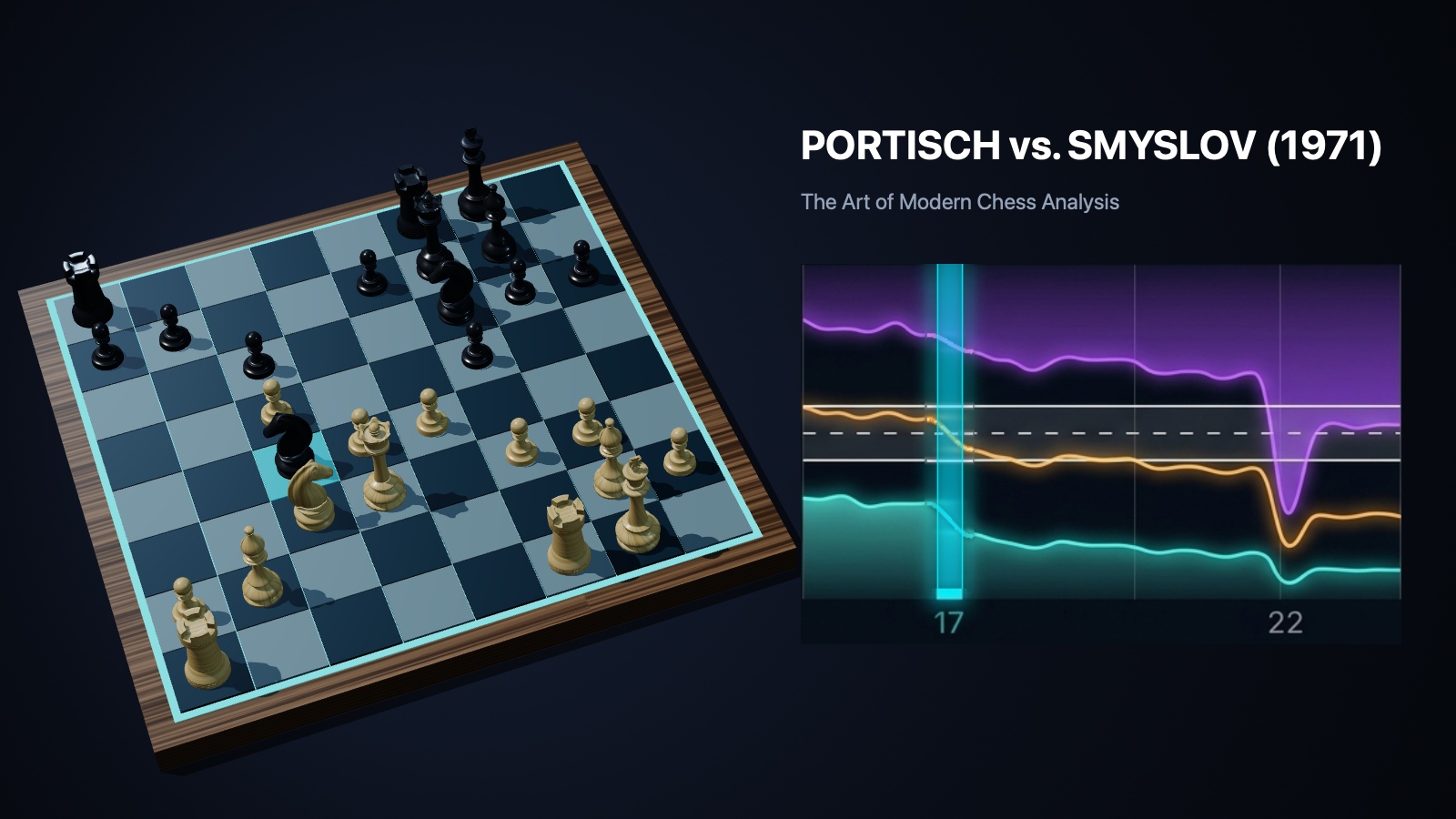
The Art of Modern Chess Analysis:
The Search for Truth
To analyze a game of chess is to search for truth, but "truth" in chess has radically evolved over the last half-century. In the pre-computer era, the gold standard of chess analysis was a rigorous, collaborative, deeply human endeavor. It required a profound mixture of intuition, meticulous calculation, and psychological insight. Today, there is still plenty to learn from human insight, but we also look through the lens of modern engines. Ultimately, analysis without insight is just noise, and insight without analysis is just guesswork. The true "art" of analysis happens when human curiosity directs the power of technology to solve the right problems. This tension between human curiosity and machine capability is a modern concern across many disciplines, as mathematician Terry Tao recently explored: A Severe Misalignment of AI in Mathematics
In his book Smyslov famously wrote:
The content of a game should be a search for truth, and victory a demonstration of its rightness. No fantasy, however rich, no technique, however masterly, no penetration into the psychology of the opponent, however deep, can make a chess game a work of art if these qualities do not lead to the main goal – the search for truth.
125 Selected Games Volume II: 1958–1990
The Players
- Lajos Portisch
-
Widely nicknamed "The Hungarian Botvinnik" by the Soviets, due to his disciplined, scientific, and deeply prepared approach to the openings. Portisch himself was never entirely comfortable with the label. Read his ChessBase interview. As of this writing, The Sportsman of the Nation is 89 years old and is still in good health, recently performing an aria at the 45th FIDE Chess Olympiad.
- Vasily Smyslov
-
Universally celebrated in chess history for his smooth, intuitive harmony, the former World Champion viewed chess as an art form rather than a science, relying heavily on seamless piece coordination and flawless endgame technique. Sharing his personal insights in Smyslov’s Best Games Volume II: 1958-1990, he offers an invaluable, deeply subjective strategic perspective from the man who actually wielded the pieces. Former World Chess Champion Vasily Smyslov passed away on March 27, 2010, at the age of 89. To the end, though he was awed by the abilities of chess engines, he maintained that the true soul of chess remained a human endeavor. An interesting read is I am Still Needed in this World!.
- Jan Timman
-
Provides pure human grandmaster insight in his seminal work, The Art of Chess Analysis, which explicitly opens with this 1971 clash from Portoroz. Timman highlights the precise friction between the two masters: how Portisch handled the position with his typical methodical, somewhat dogmatic structural views, while Smyslov treated the Leningrad Variation of the Dutch Defense in a highly unconventional, piece-active manner. See his 2020 interview with Judit Polgar. Jan Timman passed away in February 2026.
- Leela Chess Zero & Grandmaster Studio
-
Running within the Macintosh application Grandmaster Studio, Leela Chess Zero (LC0) provides the ultimate arena for modern chess analysis. By calculating Win/Draw/Loss probabilities rather than just the best moves, it tracks pawn structure statistics and leverages pure neural-network positional intuition. This allows Leela to expose hidden undercurrents that human eyes—even those of past World Champions—never saw.
Tracking the Points of Insight
To structure this modern approach to chess analysis, critical moments are taken directly from the points where both Smyslov and Timman felt it important to stop and comment. Where these two legendary minds overlap, we gain insight on how grandmasters see a game. This is something a computer cannot teach. The intent of this article is to "contribute to the conversation" as FIDE Master Andy Lee wrote in What Timman Knew by going beyond just computer analysis and searching for a method to truly improve our chess game. I hope the conversation continues at the surprise at move 20.
While human eyes may have their limits, the climax of modern analysis comes not when Leela, Stockfish or some other engine illuminates a hidden critical moment that grandmasters overlooked. But the true climax comes when we examine a profound moment—such as when Portisch missed a golden opportunity—and ask why. What happens when Timman’s pursuit of perfection and Smyslov’s classical harmony, are cross-examined by a neural network trained on millions of games? Let’s dive into the moves and explore the true state of modern chess artistry.
Background
The 1971 Candidates Matches served as the high-stakes knockout bracket to determine who would challenge reigning champion Boris Spassky in the famous 1972 Spassky vs. Fischer World Chess Championship. The road to the 1972 World Chess Championship began with the massive 24-player 1970 Palma de Mallorca Interzonal, where the top six finishers earned direct qualification to join seeded players Tigran Petrosian and Viktor Korchnoi in the 1971 Candidates Matches. While the rest of the matches featured tense, grueling, and heavily positional chess full of quiet draws, Bobby Fischer famously went on the most shockingly dominant run in classical chess history.
In chess, ties for reserve spots in the candidates matches were typically decided by a playoff. Portisch and Smyslov, having tied for seventh at the 1970 Palma de Mallorca Interzonal, played a six-game match that ended in a 3-3 draw. Since no candidate withdrew, the match was simply concluded rather than extended. Although effectively an exhibition, this matchup produced several fascinating games, especially this one. Smyslov employed a highly unconventional approach to the Leningrad Dutch. Portisch, usually known for his methodical opening preparation and somewhat rigid middlegame play, seemed thrown off balance. Rather than playing for a slight positional edge, he entered into complications that Smyslov appeared to assess much more accurately.
The Game
1. d4 f5
Jan Timman, in his famous book, stated that as far as he was aware, Smyslov had never played the Dutch Defense. Well, Timman did not have access to a chess database. The primary method for obtaining timely chess information and game scores in 1980 was through specialized print publications, tournament bulletins, and international periodicals.
A database search will inform one that Smyslov ironically played the Dutch Defense against Mikhail Botvinnik, who was very familiar with the Dutch defense, during the 1958 World Championship. Smyslov beat Botvinnik with the defense Botvinnik was so familiar with, winning that game in 38 moves!
- Smyslov wrote
-
"The choice of opening plays an important role in one’s creative approach to a game of chess and it depends on the most diverse factors. The Dutch Defense occurs rather rarely in my games, but here I wanted to play actively from the very first moves."
2. g3
At the time, Smyslov was not concerned that Portisch might play 2.e4. Smyslov played 1. d4 f5 2. e4 (the Staunton Gambit) against Mikhail Botvinnik at the Budapest Maróczy Memorial tournament in 1952. Smyslov was playing White, and Botvinnik, playing Black, successfully neutralized the gambit and went on to win the game in 27 moves.
Today a Dutch Defense player needs to be prepared for a possible Hopton Attack with 2.Bg5! David Navara vs. Ivan Ivanisevic (2012) European Individual Championship — proved that the structural and attacking ideas hold up under the scrutiny of long time controls against a 2630+ GM. Oh, by the way, it is Leela’s top recommended move.
2... ♞f6 3. ♝g2 g6
This line is called the Semi-Leningrad variation of the Dutch Defense.
4. ♞f3
Timman again is surprised that Portisch did not fight the Leningrad in the manner popularized by Taimanov.
However, the engines indicate there is little difference between 4.c4, 4.Nf3, 4.Nh3, 4.b3, 4.d5, 4.Nd2, and 4.a4. This might be what Jonathan Rowson refers to as "Doing Nothing." In his influential works—most notably The Seven Deadly Chess Sins and Chess for Zebras—Jonathan Rowson explicitly diagnoses human chess failures as psychological crises of the ego. The engine is telling you that the most accurate way to play the position is to make slow, healthy developing moves, maintain the status quo, and simply wait.
Some say Magnus Carlsen revolutionized modern chess by weaponizing patience.
Variation: 4. c4
4. c4 ♝g7 5. ♞c3 O-O 6. ♞h3
The brilliance of Taimanov’s system that Timman was referring to lies in how White develops the King’s Knight. By placing the Knight on h3 rather than the traditional f3 square, White accomplishes three strategic goals against the Leningrad setup:
-
Unblocking the f-pawn: By keeping the f3-square clear, White preserves the option to play an eventual f2-f3 followed by e2-e4, allowing White to forcefully seize control of the absolute center.
-
Targeting the e6-square: From h3, the Knight can jump to f4, where it eyes the d5 and e6 squares, severely cramping Black’s light-squared Bishop and restricting Black’s liberating pawn breaks.
-
Preventing tactical pins: It takes the sting out of any potential pin or tactical counter-play Black might attempt on the long diagonal.
Timman points out that this exact system was highly popular at the time and was used effectively in the 1971 Championship of the Netherlands.
Portisch simply opted for the quieter 4.Nf3 instead.
4... ♝g7 5. b3
Timman thought this line was first used in 1960 by Trifunović against Matulović. However, one earlier recorded master-level game featuring this exact position on move 5 was played on February 27, 1925, between Richard Réti and Savielly Tartakower during the famous Baden-Baden 1925 chess tournament.
(Note that Leela lists 5.b3 first (Stockfish about 3rd), with very little difference between 5…d5, 5…O-O, 5…c6, and 5…Ne4). In other words, Portisch's position is fine; Leela and Stockfish approve.
5... O-O 6. ♝b2 d5!?
Smyslov indicated in his writings that this move was played in the spirit of the system known in opening theory as the "Stonewall."
In Grandmaster Mauricio Flores Ríos’s book Chess Structures – A Grandmaster Guide (2015), he writes that the Stonewall structure arises from the Dutch Defense, the Slav, or the Catalan, with the Dutch being the most common. He notes that the Stonewall has one of the worst reputations among pawn structures, with players from all levels claiming that …d7-d5 combined with …f7-f5 is positionally unsound.
The Classical Pioneers
When Smyslov played the Stonewall against Portisch in 1971 (and when Botvinnik played it in the 1950s), they were swimming against the theoretical current. The skepticism toward the Stonewall Dutch can be traced back to highly influential classical texts, most notably Siegbert Tarrasch’s 1931 work The Game of Chess, where he explicitly rejected the entire Dutch Defense as unsound. This critical view was later echoed in standard opening manuals like Modern Chess Openings (MCO) and the Encyclopedia of Chess Openings (ECO), which historically treated the Stonewall as an inferior, second-tier defense due to its static structural weaknesses.
These legendary world champions succeeded because of their profound positional understanding and their ability to outplay their opponents in the resulting complex middlegames.
The Modern Re-Evaluation
What makes the Stonewall "modern" today is how we understand it:
The Human Era: Players like Smyslov played it despite the structural weaknesses, relying on "feel" and practical chances.
The Engine Era: Modern neural networks (like Leela) have mathematically validated Smyslov’s intuition. They have shown that the dynamic attacking chances Black gets are fully equal to White’s static structural advantages.
In short, Smyslov was ahead of his time. He was playing "modern" chess half a century before the computers arrived to prove him right.
Timman found Smyslov’s Stonewall setup very unusual in this position, and in The Art of Chess Analysis continues with an in-depth study of the popular variations.
Leela’s evaluation of the variations (6…b6, 6…d6, 6…a5, 6…c6, 6…e6, 6…Ne4, 6…d5) is that the win/draw/loss gap between the top and bottom is a minimal 2%, indicating most reasonable moves are playable. The position remains equal, with no single line offering a decisive advantage.
7. c4 c6 8. O-O ♝e6!? 9. ♞g5 ♝f7 10. ♞c3 ♛e8?!
Timman finds this move to be 'strange'. Leela agrees. It gives white a slight edge. Perhaps it is a bit too passive. Leela places any of these moves as better (10…e6,10…Bh6,10…a5,10…Ne4,10…h6,)
This position strikes me as what Jonathan Rowson would call "doing nothing". Rowson argues that against a solid opponent, actively trying to create something out of nothing is a psychological trap. Instead, he suggests maintaining a good position and waiting; literally "doing nothing" constructive can sometimes force the opponent to try and make progress until they make a mistake.
11. ♛d3
Timman found this move to be a bit odd. It’s not; (11.e3, 11.f3, 11.Rc1, 11.Qd3, 11.a4) all are roughly equivalent. Stockfish and Leela claim White has a 25% chance of winning and a negligible chance of losing.
Variation: 11. ♜c1
11. ♜c1 h6 12. ♞xf7 ♛xf7 13. ♞a4 ♞a6 14. cxd5 cxd5 15. b4 e6 16. b5 ♞c7 17. ♛b3 ♜fd8 18. ♜c2 ♞ce8 19. ♝a3 ♜ac8 20. ♜fc1 ♜xc2 21. ♜xc2 ♞e4 22. e3 b6 23. ♞b2 ♛d7 24. ♜c6 ♜c8 +0.69 wdl:[42%,42%,15%]
11... h6 12. ♞xf7 ♛xf7 13. f3 ♞bd7
Smyslov decided on "an active plan, preparing to open the centre with e2-e4. 13 cxd5 cxd5 14 Qb5 was not dangerous in view of 14…e6, for example: 15 Na4 Nc6 16 Nc5 Ne4! and Black gains equal chances by the attack on the d4 pawn." Has Smyslov decided to go from doing nothing to doing something? Not yet. But Leela tells us that Black needs to tread carefully.
14. e4
Smyslov realizes that White’s position seems preferable. Leela agrees. Smyslov sees that exchanges on e4 allow the bishops to become strong, while if 14…e6 there follows 15 e5 — 16 f4 with clear spatial gains. This is actually an important insight. Consider the position Smyslov is describing. It will become important two moves later.
14... dxc4!
This move keeps the position relatively equal. Smyslov states that "Black’s counterplay is based on a piece attack against the white pawn centre." The question is whether he succeeds in finding a vulnerable point in White’s pawn chain by penetrating with his knight to c4, as Timman believes.
15. bxc4 ♞b6 16. c5 ♞c4
What is the best move for white?
17. ♝c1?
Portisch misplays the position. It is important to note that neither White nor Black is winning. So Portisch must have missed another opportunity.
Both Smyslov and Timman felt that Black’s counterplay against the White center was winning. Well, it certainly provided the opportunity for White to make a mistake.
This is truly a critical position. Leela Chess Zero indicates this position is SHARP (EV spread of 46.3% across the top lines, making it a forced corridor where inaccurate intuition is punished).
What is it in this position where human grandmaster intuition (Portisch playing 17. Bc1, with Smyslov and Timman assessing Black as better) creates a human blind spot?
Smyslov indicated earlier that 15. e5 and a center expansion was a concern to him. Well, it turns out that Portisch has a counterattack opportunity as well.
True master-level trading requires the cold-blooded willingness to accept an ugly, unconventional position if it strips your opponent of their actual playing density.
The Consequences of 17. Bc1?
By playing 17. Bc1?, Portisch kept his bishop pair but paid a catastrophic positional toll by Handing Over the Initiative. Instead of forcing Smyslov to justify his forward knight leap, Portisch allowed the knight to remain a dominant outpost on c4 without giving anything up. Smyslov smoothly consolidated his position and went on to win the game.
If avoiding an exchange forces your pieces into passivity (like Bc1), the trade is almost always better than the retreat.
Smyslov’s suggestion:
Variation: 17. ♜ab1
17. ♜ab1 ♜fd8
and ironically now
18. ♝c1 ♞d7 19. d5 ♞a5 20. ♝e3 cxd5 21. ♞xd5 e6 22. ♛b5 exd5 23. ♛xa5 d4 24. ♝f2 fxe4 25. fxe4 b6 26. cxb6 axb6 27. ♛d5 ♛xd5 28. exd5 ♜xa2 29. ♜fd1 ♜a4 30. d6 ♚h7 31. ♝c6 ♜c4 32. ♝b5 ♜c5 33. ♝xd4 ♝xd4+ 34. ♜xd4 ♚g7 35. ♝a4 ♞e5 -0.01 wdl:[25%,49%,26%]
Smyslov’s insight (pushing the e-pawn and expanding the center):
Variation: 17. ♛e2
17. ♛e2!! f4 18. e5 ♞xb2 19. ♛xb2 ♞d5 20. ♞xd5 ♛xd5 21. ♜fd1 ♜ab8 22. ♛b3 ♛f7 23. ♜ac1 h5 24. ♚f2 ♝h6 25. ♜c3 ♛xb3 26. ♜xb3 b6 27. cxb6 ♜xb6 28. ♝f1 ♚g7 29. ♝c4 fxg3 30. hxg3 h4 31. gxh4 ♝f4 32. ♚e2 ♜h8 33. ♚d3 ♜xh4 34. ♜db1 ♝g3 35. ♜xb6 axb6 36. ♜xb6 ♝f2 37. ♜xc6 ♜xd4+ 38. ♚e2 ♝g3 39. a4 ♝xe5 +0.40 wdl:[312,553,135]
17... ♜ad8 18. ♜b1 ♞d7
Smyslov notes that Black will attempt to intensify the pressure on the central pawns, at the same time parrying the threat of 19 Rxb7 by 19… Nxc5. If 19 Ne2, then 19… Nxc5 20 Qc2 Bxd4+ 21 Nxd4 Rxd4 22 Bxh6 Rfd8 and Black wins a pawn.
19. d5 b5
Smyslov is right in saying that Black has the initiative and succeeds in maintaining the knight in its strong position.
20. dxc6
Another poor choice by Portisch. Neither Timman nor Smyslov realized that Portisch still had chances with:
Variation: 20. ♞xb5
What?? Imagine Smyslov’s shock had Portisch found this move.
20. ♞xb5!! cxb5 21. ♜xb5 ♞de5 22. ♛e2 fxe4 23. fxe4 ♛e8 24. ♜b4
And the position is double-edged. Black would need to be precise with:
24... ♜b8
-
If Black played 24…Rxf1+ the advantage would return to White:
Variation: 24… ♜xf1+
24... ♜xf1+? 25. ♝xf1 ♞a5 26. ♛a6 ♛f7 27. ♝f4 ♚h7 28. c6 ♞axc6 29. dxc6 ♜d6 30. ♝xe5 ♝xe5 31. ♛c4 ♛f8 32. ♝e2 ♜d2 33. ♜b1 ♝d4+ 34. ♚h1 ♛f2 35. ♜f1 ♛xe2 36. ♛xe2 ♜xe2 37. ♜c1 ♝b6 38. c7 ♝xc7 39. ♜xc7 ♜xa2 40. ♜xe7+ ♚g8 41. e5 a5 42. e6 +0.13 wdl:[25%,57%,18%]
25. ♜xc4 ♞xc4 26. ♛xc4 ♛b5 27. ♜xf8+ ♚xf8 28. ♛xb5 ♜xb5 29. ♝e3 ♜a5 30. c6 ♜xa2 31. ♝h3 ♝e5 32. ♝xh6+ ♚e8 33. ♝g7! ♝c7 34. ♝d7+ ♚f7 35. ♝d4 ♜a4 36. ♝c5 ♚f6 37. ♚f2 a5 38. ♚e2 ♜c4 39. ♝e3 a4 40. ♚d3 ♜b4 41. ♝c5 ♜b5 42. ♝d4+ ♚f7 43. ♚c2 a3 44. ♝e6+ ♚f8 45. e5 ♚e8 46. h4 ♜b4 47. ♝c3 ♜e4 48. g4 ♚d8 49. ♚b1 ♜e3 50. ♝d4 ♜d3 51. ♝c5 ♜c3 52. ♝d4 ♜c4 -0.31 wdl:[18%,50%,31%]
20... ♞xc5 21. ♛c2 a6
Here we can assess the results of this lively middlegame. Of White’s pawn centre, there remains only the passed c-pawn, which is more a source of concern for him than a strength. The Black knights occupy active posts on the queenside. If 22 exf5, then 22… Qxf5 23 Qxf5 gxf5 24 Ne2 Rd6 25 f4 Ne4 and the c6 pawn is doomed.
22. f4??
This is the losing move. Neither Timman nor Smyslov commented on Portisch’s opportunities to draw with:
Variation: 22. a4
22. a4 ♝xc3 23. ♛xc3 ♞xa4 24. ♛e1 ♚h7 25. exf5 gxf5 26. f4 ♜d6 27. ♜a1 ♛f6 28. ♜a2 ♞c5 29. ♜e2 e6 30. ♝e3 ♞d3 31. ♛a1 ♛xa1 32. ♜xa1 b4 33. ♜xa6 b3 34. ♜a7+ ♚g8 35. ♜b7 b2 36. h3 ♞a5 37. ♜bxb2 ♞xb2 38. ♜xb2 -0.52 wdl:[166,459,375]
Variation: 22. exf5
22. exf5 ♛xf5 23. ♞e4 ♞e6 24. g4 ♛e5 25. ♚h1 ♞d4 26. ♛f2 ♛c7 27. f4 ♛xc6 28. g5 ♛e6 29. gxh6 ♝xh6 30. a4 ♞e5 31. axb5 ♞d3 32. ♛e3 ♞xf4 33. ♞g3 ♛xe3 34. ♝xe3 -0.45 wdl:[155,500,345]
22... ♝xc3 23. ♛xc3 ♞xe4 24. ♝xe4
Thus the bishops have been unable to display their long-range power and in the battle with the knights they have been forced to give way. Indeed, if 24 Qc2, then 24… d5 25. c7 Rd7 with advantage to Black.
24... fxe4 25. a4 ♛f5 26. axb5 axb5 27. ♝b2 ♜f6 28. ♝a1 ♛c5+ 29. ♚h1 ♛xc6 30. ♜bd1
Directed against the threat of 30…Rd2.
30... e3+ 31. ♚g1 ♜d2 32. ♜xd2 exd2 33. ♛d3 ♜d6 34. ♛c3 e5 35. ♜d1 ♛c5+ 36. ♚h1 ♛e3 37. fxe5 ♜d3